
InstrumentFlagship
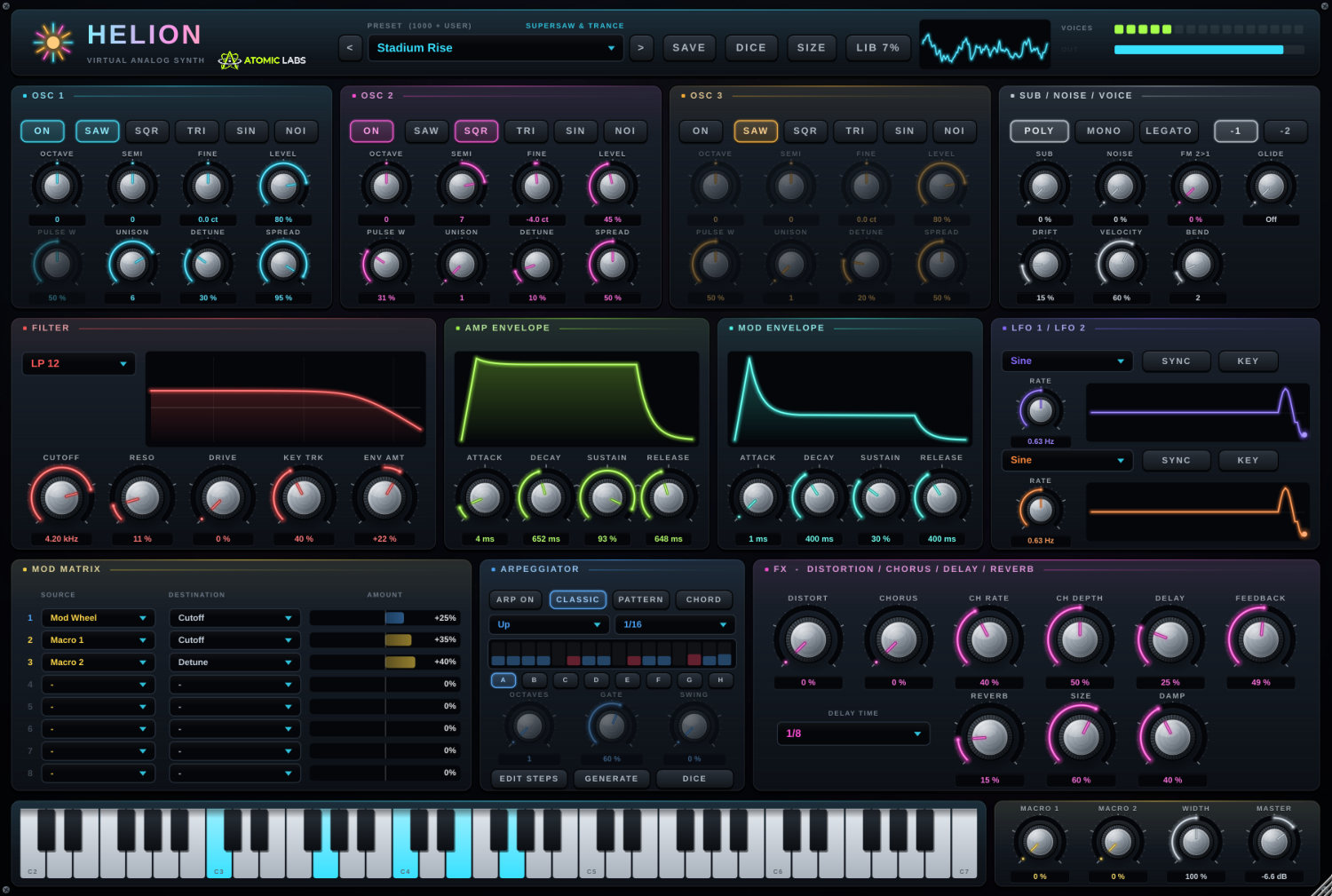
Helion
16-voice virtual-analog polysynth
1,000 presets · 107 controls
Coming soonGet the pack
Type a few words like "warm acid bass" or "airy pad with shimmer" and get a real synth patch: play it on your keyboard, tweak every control, and save it as a patch file or a WAV. Nothing you type leaves your computer.
Start with what the sound is (a bass, pad, pluck, lead or bell), then say how it sounds, how it moves and how much space it has. "Warm" lowers the filter and adds a little drive; "plucky" means a fast attack and a short decay; "wide" stacks detuned voices with chorus. Words like "very", "slightly" and "no" change how strongly a word counts: "pad with no reverb" really turns the reverb off. Here is what some of the 138 word groups set:
| Word | Also understood | What it sets |
|---|---|---|
| bass | bassline, basses | osc 1 wave saw · mono mono · octave -1 · filter cutoff 900 Hz · amp attack 3 ms · amp release 120 ms |
| sub | sub bass, subbass, 808 | osc 1 wave sine · mono mono · octave -2 · filter cutoff 220 Hz · resonance 5% · osc 1 level 90% |
| pad | pads, padding, texture | mono poly · amp attack 800 ms · amp decay 1.5 s · amp sustain 85% · amp release 2.2 s · filter cutoff 2,200 Hz |
| pluck | plucks, plucked, plucky | mono poly · amp attack 2 ms · amp decay 220 ms · amp sustain 0% · amp release 180 ms · filter env attack 1 ms |
| lead | leads, solo, melody | mono mono · osc 1 wave saw · octave 0 · filter cutoff 3,500 Hz · amp attack 4 ms · amp sustain 80% |
| bell | bells, chime, chimes | osc 1 wave sine · osc 2 wave sine · mono poly · amp attack 1 ms · amp decay 2.2 s · amp sustain 0% |
| warm | warmth, cozy, cosy | filter cutoff 1,500 Hz · drive 15% · chorus 15% |
| bright | brilliant, brighter | filter cutoff 9,500 Hz · filter env amount 30% |
| dark | darker, murky, gloomy | filter cutoff 450 Hz · resonance 20% |
| airy | air, breathy, breath | noise 18% · filter cutoff 6,000 Hz · reverb 35% |
| metallic | metal, clangy, industrial | osc 1 wave square · osc 2 wave square · type bandpass · osc 2 level 70% · osc 2 semi +13 st · osc 2 detune 31 cents |
| wide | stereo, spacious, panoramic | osc 1 unison 5 voices · osc 1 spread 26 cents · chorus 50% |
| punchy | punch, tight, snappy | amp attack 1 ms · amp decay 150 ms · filter env decay 80 ms · filter env amount 50% · amp release 80 ms |
| gritty | grit, dirty, grimy | drive 60% · noise 10% |
| acid | acidic, 303, tb303 | osc 1 wave saw · type lowpass · mono mono · filter cutoff 420 Hz · resonance 86% · filter env amount 70% |
| wobble | wobbly, wub, wubs | LFO target cutoff · LFO wave sine · LFO rate 3 Hz · LFO depth 80% · filter cutoff 500 Hz · resonance 45% |
When words pull the same control different ways, each one counts by its weight, so "dark bright pad" lands in between.
Two oscillators (saw, square, sine, triangle or supersaw, each with up to 7 detuned unison voices), a noise source, a filter (low-pass, high-pass, band-pass or notch) with its own envelope, an amp envelope, one LFO that can move the filter, pitch, volume or pan, and drive, chorus, delay and reverb. A limiter keeps the output under -1 dBFS, and up to 8 notes play at once. Every value is shown in the patch panel, so you can see exactly what your words did.
Click the on-screen keys, or use your computer keyboard: A W S E D F T G Y H U J K play one octave from C, Z and X move the octave. Press Connect MIDI to play from a MIDI keyboard, in browsers that support Web MIDI (Chrome and Edge). Sound only starts when you press a key or a button.
There is no AI model and no server. The page reads your words with a fixed set of rules: each known word or phrase pulls some controls towards its values, by its weight. "New ideas" makes four variations of the same words with a seeded random spread, so the same words and the same click give the same four sounds. The sound itself comes from your browser's Web Audio engine.
Need a tempo-synced delay on that patch? Get the time from the delay calculator. Tuning a sub to your track? Check its note in frequency to note.
Yes. There is no account, no limit and no watermark.
Real patches. Your words set the controls of a two-oscillator synth: wave, filter, envelopes, LFO and effects. You can see every value in the patch panel and change it, and the synth plays live as you press keys.
Yes. The patches you make and the WAV files you render are yours to use in any music, including releases you sell.
Your words are read by a set of rules in this page (no AI model, no server), and the sound is made by your browser's audio engine. Nothing you type or play is sent anywhere. Once the page has loaded it keeps working without a connection.
You can save the patch as a JSON file in the open atomic-synth-patch v1 format, and render a note or a chord as a 24-bit WAV. Our VST3 synths don't load these files yet.
Name the role first (bass, pad, pluck, lead, bell), then how it sounds (warm, bright, dark, metallic, airy), how it moves (wobble, evolving, slow attack) and the genre. The table on this page shows what each word changes.
Atomic Labs instruments with hundreds of presets each: polysynths, wavetables, basses and more.
16-voice virtual-analog polysynth
1,000 presets · 107 controls
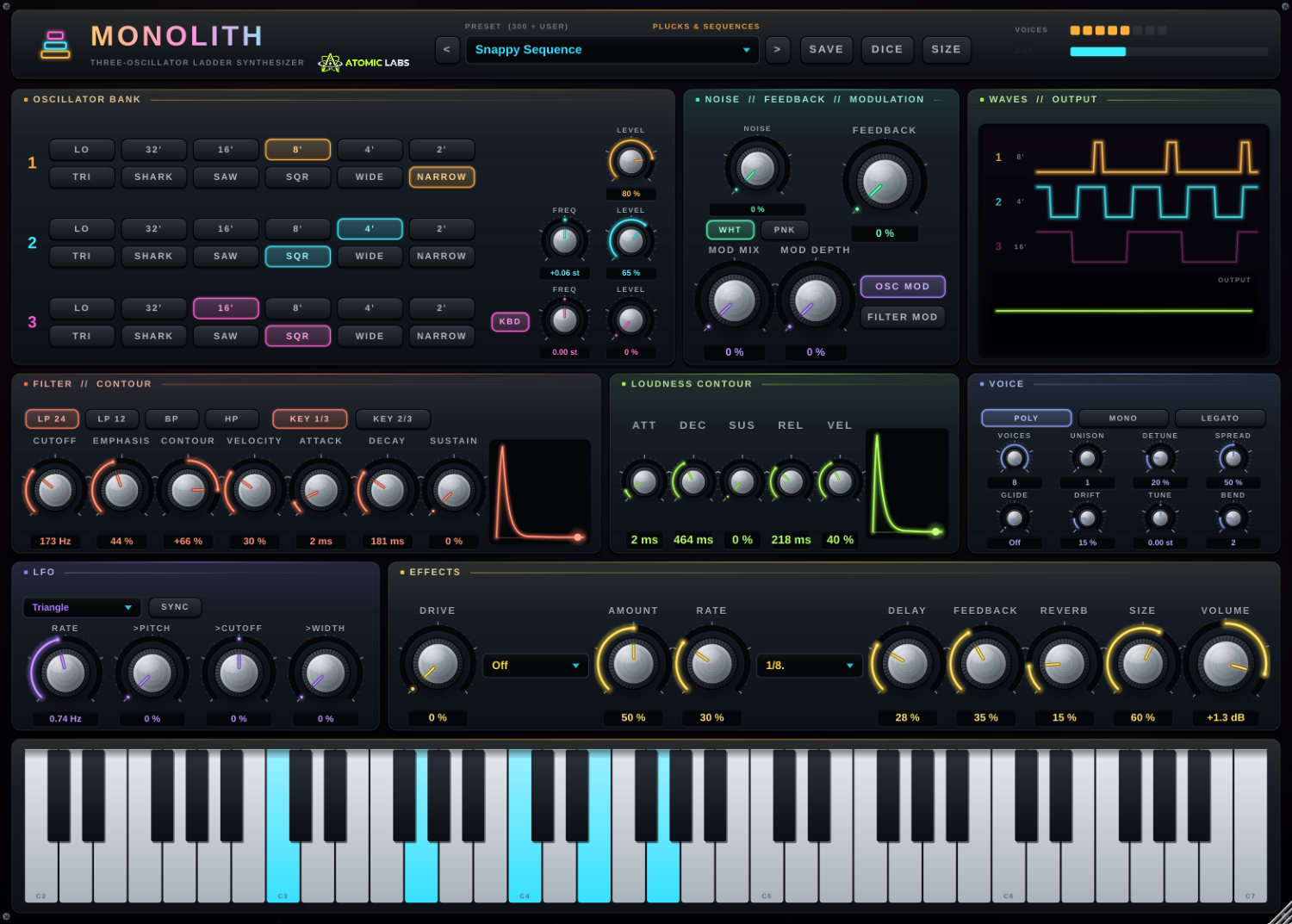
Three-oscillator ladder synthesizer
300 presets · 60 controls
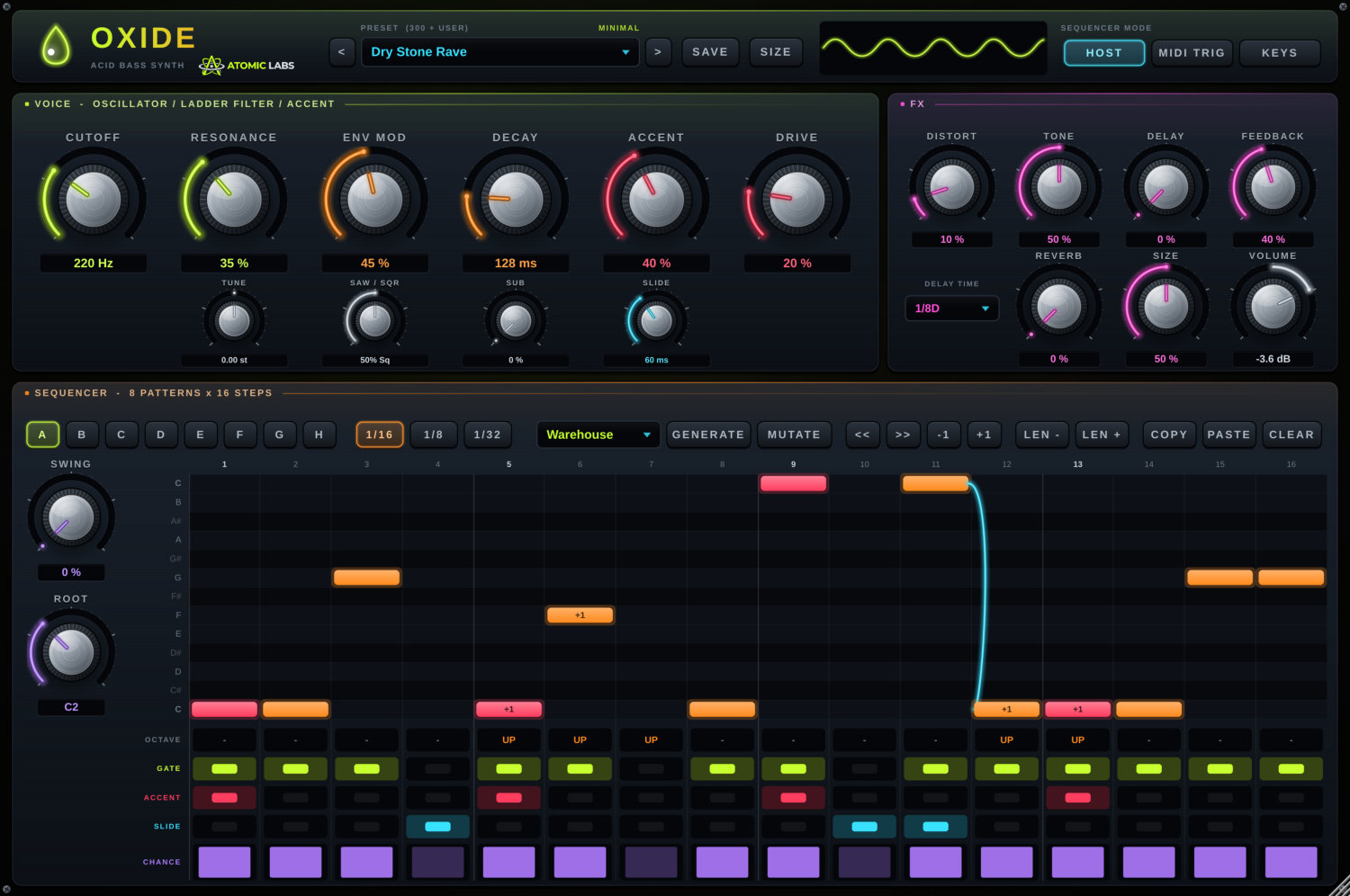
Acid bass-line synthesizer with sequencer
300 presets · 23 controls
Delay times for every note value, reverb pre-delay and decay, tap tempo, and a loop you can hear with straight, dotted and triplet echoes.
FreeTurn any frequency into its note, cents and MIDI number, or a note into Hz, at 432, 440, 442 or your own A4. With a full note table and tones to compare.
FreeBuild a wavetable from harmonics, a formula or your own drawing, watch it morph in 3D, hear it, and save a WAV for your wavetable synth.
FreeSplit a song into 6 stems (vocals, drums, bass, guitar, piano, other) on your own computer, mix them and save each one as WAV.
All toolsEverything we make for free, in one place, and what's coming next.
Shop151 instruments and effects for every Windows DAW.