
InstrumentFlagship
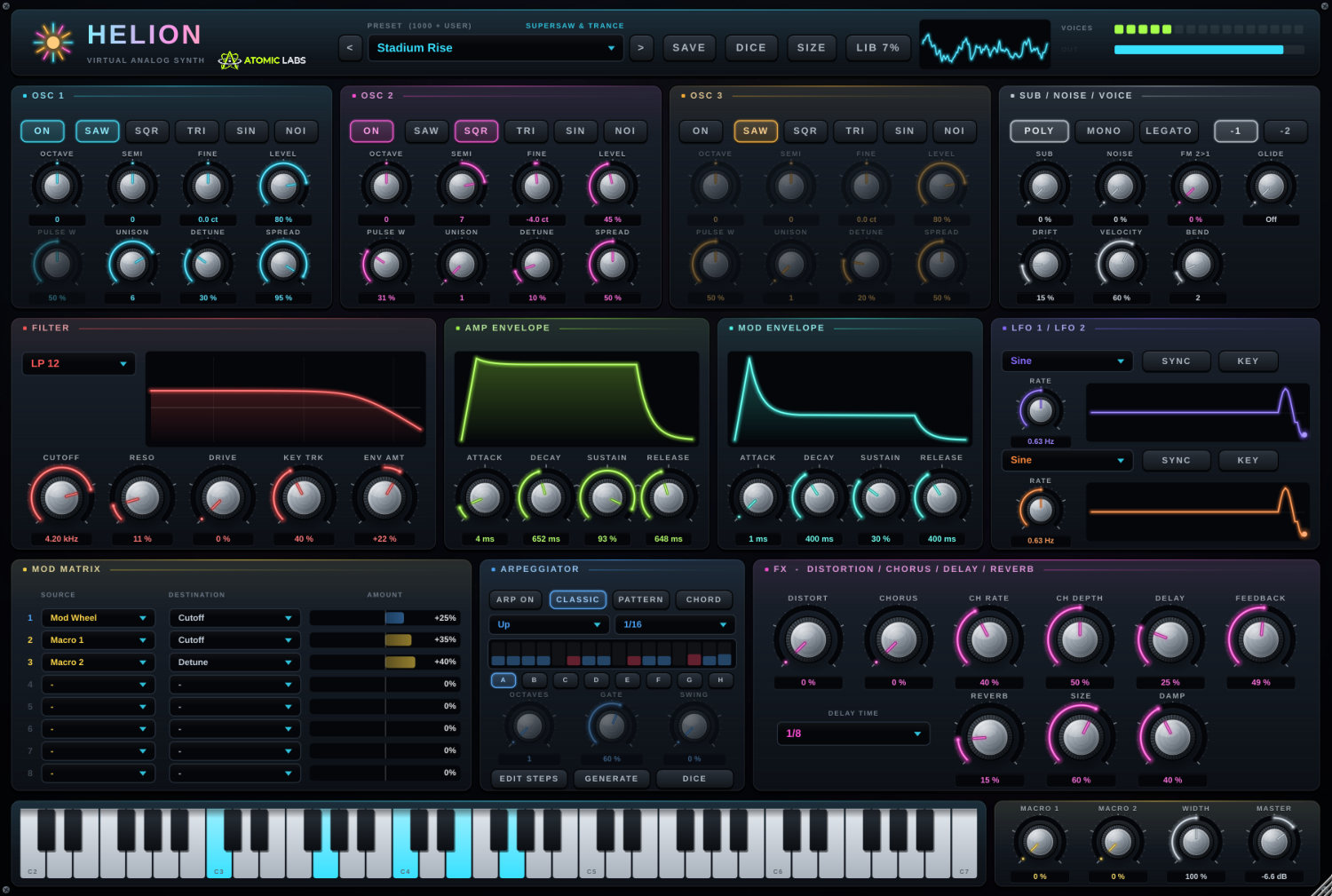
Helion
16-voice virtual-analog polysynth
1,000 presets · 107 controls
Coming soonGet the pack
Type a frequency to see its note, how many cents it is off, its MIDI number and more. Or type a note to get its frequency. Then listen to how close they are.
Exactly on the note: no beating.
Try 445 Hz and press "Both together": you will hear the volume pulse 5 times a second.
C4 = 261.626 Hz · MIDI 60
At A4 = 440 Hz. Search a note (A4, Bb2), a name (C#) or a frequency (87). Click a row to analyse it.
| Note | MIDI | Hz | Period ms | Wavelength |
|---|---|---|---|---|
| C0 | 12 | 16.352 | 61.156 | 20.98 m |
| C#0 | 13 | 17.324 | 57.724 | 19.8 m |
| D0 | 14 | 18.354 | 54.484 | 18.69 m |
| D#0 | 15 | 19.445 | 51.426 | 17.64 m |
| E0 | 16 | 20.602 | 48.54 | 16.65 m |
| F0 | 17 | 21.827 | 45.815 | 15.71 m |
| F#0 | 18 | 23.125 | 43.244 | 14.83 m |
| G0 | 19 | 24.5 | 40.817 | 14 m |
| G#0 | 20 | 25.957 | 38.526 | 13.21 m |
| A0 | 21 | 27.5 | 36.364 | 12.47 m |
| A#0 | 22 | 29.135 | 34.323 | 11.77 m |
| B0 | 23 | 30.868 | 32.396 | 11.11 m |
| C1 | 24 | 32.703 | 30.578 | 10.49 m |
| C#1 | 25 | 34.648 | 28.862 | 9.9 m |
| D1 | 26 | 36.708 | 27.242 | 9.34 m |
| D#1 | 27 | 38.891 | 25.713 | 8.82 m |
| E1 | 28 | 41.203 | 24.27 | 8.32 m |
| F1 | 29 | 43.654 | 22.908 | 7.86 m |
| F#1 | 30 | 46.249 | 21.622 | 7.42 m |
| G1 | 31 | 48.999 | 20.408 | 7 m |
| G#1 | 32 | 51.913 | 19.263 | 6.61 m |
| A1 | 33 | 55 | 18.182 | 6.24 m |
| A#1 | 34 | 58.27 | 17.161 | 5.89 m |
| B1 | 35 | 61.735 | 16.198 | 5.56 m |
| C2 | 36 | 65.406 | 15.289 | 5.24 m |
| C#2 | 37 | 69.296 | 14.431 | 4.95 m |
| D2 | 38 | 73.416 | 13.621 | 4.67 m |
| D#2 | 39 | 77.782 | 12.856 | 4.41 m |
| E2 | 40 | 82.407 | 12.135 | 4.16 m |
| F2 | 41 | 87.307 | 11.454 | 3.93 m |
| F#2 | 42 | 92.499 | 10.811 | 3.71 m |
| G2 | 43 | 97.999 | 10.204 | 3.5 m |
| G#2 | 44 | 103.826 | 9.631 | 3.3 m |
| A2 | 45 | 110 | 9.091 | 3.12 m |
| A#2 | 46 | 116.541 | 8.581 | 2.94 m |
| B2 | 47 | 123.471 | 8.099 | 2.78 m |
| C3 | 48 | 130.813 | 7.645 | 2.62 m |
| C#3 | 49 | 138.591 | 7.215 | 2.47 m |
| D3 | 50 | 146.832 | 6.81 | 2.34 m |
| D#3 | 51 | 155.563 | 6.428 | 2.2 m |
| E3 | 52 | 164.814 | 6.067 | 2.08 m |
| F3 | 53 | 174.614 | 5.727 | 1.96 m |
| F#3 | 54 | 184.997 | 5.405 | 1.85 m |
| G3 | 55 | 195.998 | 5.102 | 1.75 m |
| G#3 | 56 | 207.652 | 4.816 | 1.65 m |
| A3 | 57 | 220 | 4.545 | 1.56 m |
| A#3 | 58 | 233.082 | 4.29 | 1.47 m |
| B3 | 59 | 246.942 | 4.05 | 1.39 m |
| C4 | 60 | 261.626 | 3.822 | 1.31 m |
| C#4 | 61 | 277.183 | 3.608 | 1.24 m |
| D4 | 62 | 293.665 | 3.405 | 1.17 m |
| D#4 | 63 | 311.127 | 3.214 | 1.1 m |
| E4 | 64 | 329.628 | 3.034 | 1.04 m |
| F4 | 65 | 349.228 | 2.863 | 98.2 cm |
| F#4 | 66 | 369.994 | 2.703 | 92.7 cm |
| G4 | 67 | 391.995 | 2.551 | 87.5 cm |
| G#4 | 68 | 415.305 | 2.408 | 82.6 cm |
| A4 | 69 | 440 | 2.273 | 78 cm |
| A#4 | 70 | 466.164 | 2.145 | 73.6 cm |
| B4 | 71 | 493.883 | 2.025 | 69.4 cm |
| C5 | 72 | 523.251 | 1.911 | 65.6 cm |
| C#5 | 73 | 554.365 | 1.804 | 61.9 cm |
| D5 | 74 | 587.33 | 1.703 | 58.4 cm |
| D#5 | 75 | 622.254 | 1.607 | 55.1 cm |
| E5 | 76 | 659.255 | 1.517 | 52 cm |
| F5 | 77 | 698.456 | 1.432 | 49.1 cm |
| F#5 | 78 | 739.989 | 1.351 | 46.4 cm |
| G5 | 79 | 783.991 | 1.276 | 43.8 cm |
| G#5 | 80 | 830.609 | 1.204 | 41.3 cm |
| A5 | 81 | 880 | 1.136 | 39 cm |
| A#5 | 82 | 932.328 | 1.073 | 36.8 cm |
| B5 | 83 | 987.767 | 1.012 | 34.7 cm |
| C6 | 84 | 1046.502 | 0.956 | 32.8 cm |
| C#6 | 85 | 1108.731 | 0.902 | 30.9 cm |
| D6 | 86 | 1174.659 | 0.851 | 29.2 cm |
| D#6 | 87 | 1244.508 | 0.804 | 27.6 cm |
| E6 | 88 | 1318.51 | 0.758 | 26 cm |
| F6 | 89 | 1396.913 | 0.716 | 24.6 cm |
| F#6 | 90 | 1479.978 | 0.676 | 23.2 cm |
| G6 | 91 | 1567.982 | 0.638 | 21.9 cm |
| G#6 | 92 | 1661.219 | 0.602 | 20.6 cm |
| A6 | 93 | 1760 | 0.568 | 19.5 cm |
| A#6 | 94 | 1864.655 | 0.536 | 18.4 cm |
| B6 | 95 | 1975.533 | 0.506 | 17.4 cm |
| C7 | 96 | 2093.005 | 0.478 | 16.4 cm |
| C#7 | 97 | 2217.461 | 0.451 | 15.5 cm |
| D7 | 98 | 2349.318 | 0.426 | 14.6 cm |
| D#7 | 99 | 2489.016 | 0.402 | 13.8 cm |
| E7 | 100 | 2637.02 | 0.379 | 13 cm |
| F7 | 101 | 2793.826 | 0.358 | 12.3 cm |
| F#7 | 102 | 2959.955 | 0.338 | 11.6 cm |
| G7 | 103 | 3135.963 | 0.319 | 10.9 cm |
| G#7 | 104 | 3322.438 | 0.301 | 10.3 cm |
| A7 | 105 | 3520 | 0.284 | 9.7 cm |
| A#7 | 106 | 3729.31 | 0.268 | 9.2 cm |
| B7 | 107 | 3951.066 | 0.253 | 8.7 cm |
| C8 | 108 | 4186.009 | 0.239 | 8.2 cm |
| C#8 | 109 | 4434.922 | 0.225 | 7.7 cm |
| D8 | 110 | 4698.636 | 0.213 | 7.3 cm |
| D#8 | 111 | 4978.032 | 0.201 | 6.9 cm |
| E8 | 112 | 5274.041 | 0.19 | 6.5 cm |
| F8 | 113 | 5587.652 | 0.179 | 6.1 cm |
| F#8 | 114 | 5919.911 | 0.169 | 5.8 cm |
| G8 | 115 | 6271.927 | 0.159 | 5.5 cm |
| G#8 | 116 | 6644.875 | 0.15 | 5.2 cm |
| A8 | 117 | 7040 | 0.142 | 4.9 cm |
| A#8 | 118 | 7458.62 | 0.134 | 4.6 cm |
| B8 | 119 | 7902.133 | 0.127 | 4.3 cm |
No note matches. Try a name like C#3 or a number like 220.
The note number is 69 + 12 × log2(frequency ÷ 440), where 69 is A4 on the MIDI scale. Round it to get the nearest note; what is left over, times 100, is how many cents sharp or flat the frequency is.
A cent is one hundredth of a semitone. Most people can hear a difference of about 5 to 10 cents between two notes played one after the other, and less when they play together and beat.
440 Hz is the international standard, and almost all instruments, samples and plug-ins expect it. 432 Hz and 442 Hz are used by some musicians and orchestras. Pick whatever your other material is tuned to, so everything stays in tune together.
Two tones that are close in pitch drift in and out of step, so the volume pulses. The pulse rate equals the difference between the two frequencies: 445 Hz against 440 Hz beats 5 times a second. Tuners and piano tuners use this to hear how far off a note is.
Scientific pitch notation: middle C is C4 (MIDI 60) and A4 is 440 Hz. Some DAWs call middle C 'C3'; the frequencies are the same, only the label moves.
It is the length of one cycle of the sound in air (at 343 m/s, about 20 °C). It helps when placing speakers and bass traps, or working out room modes: a 55 Hz bass note is about 6.2 m long.
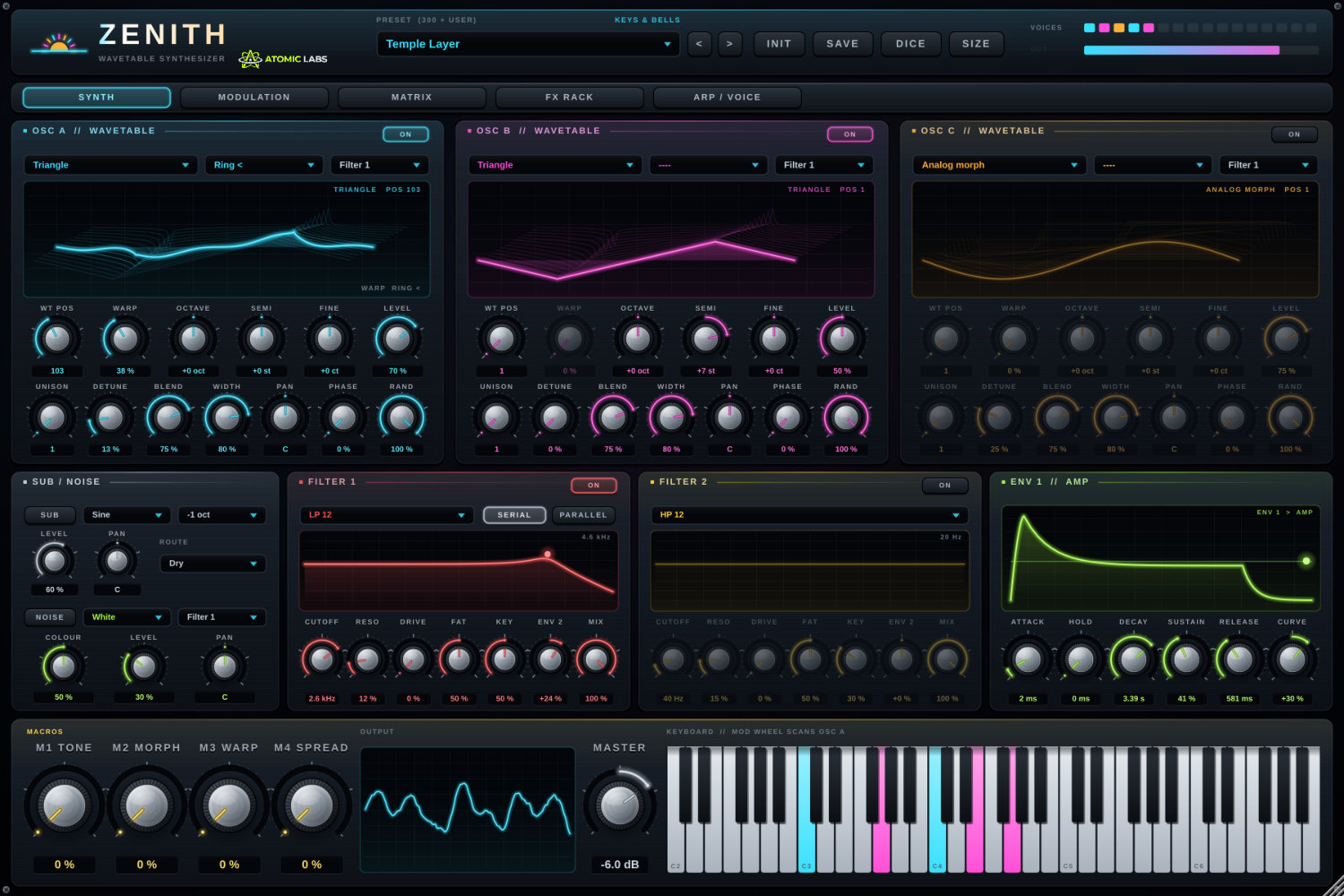
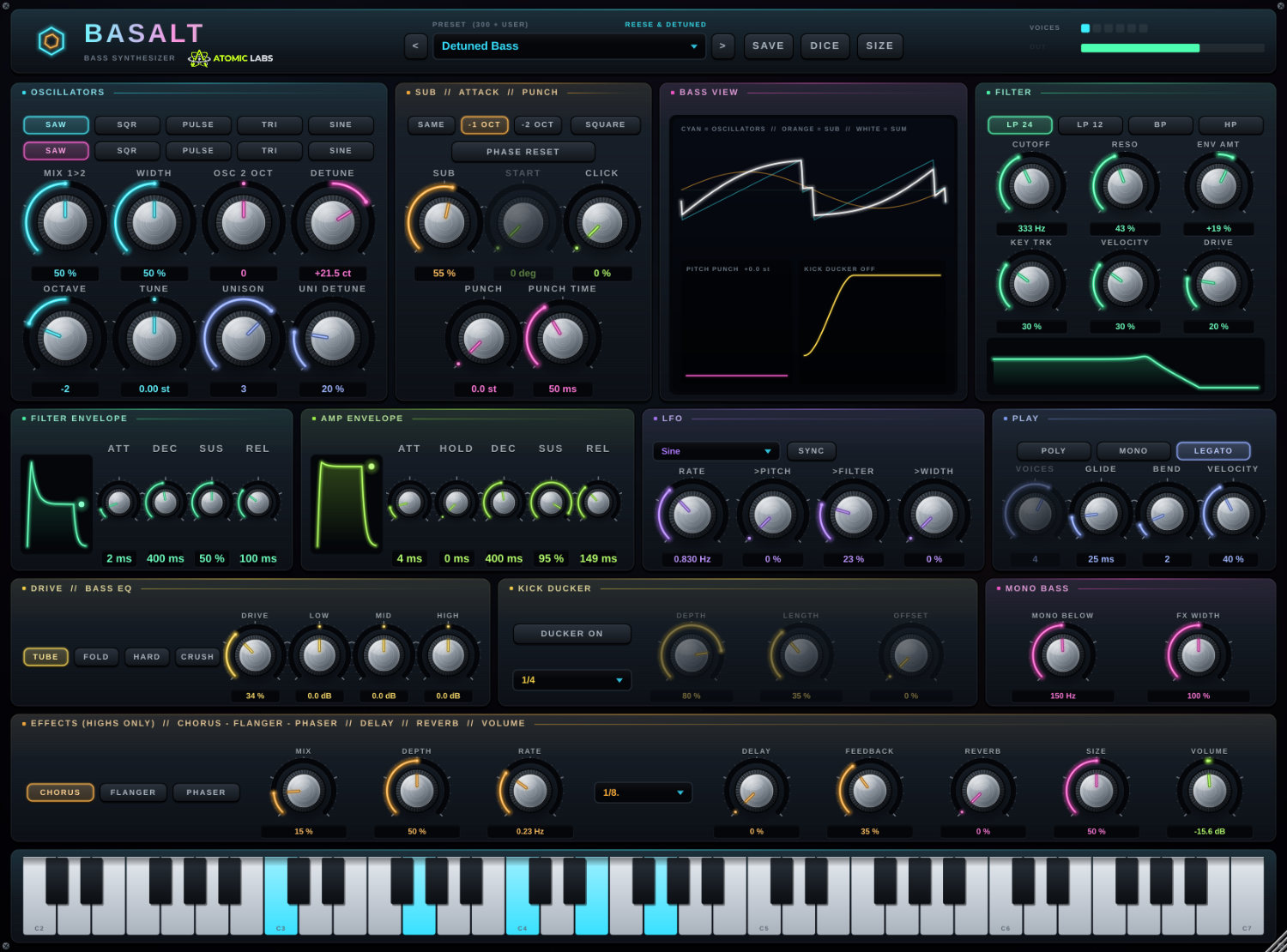
Atomic Labs instruments: polysynth, wavetable, bass and acid.
16-voice virtual-analog polysynth
1,000 presets · 107 controls
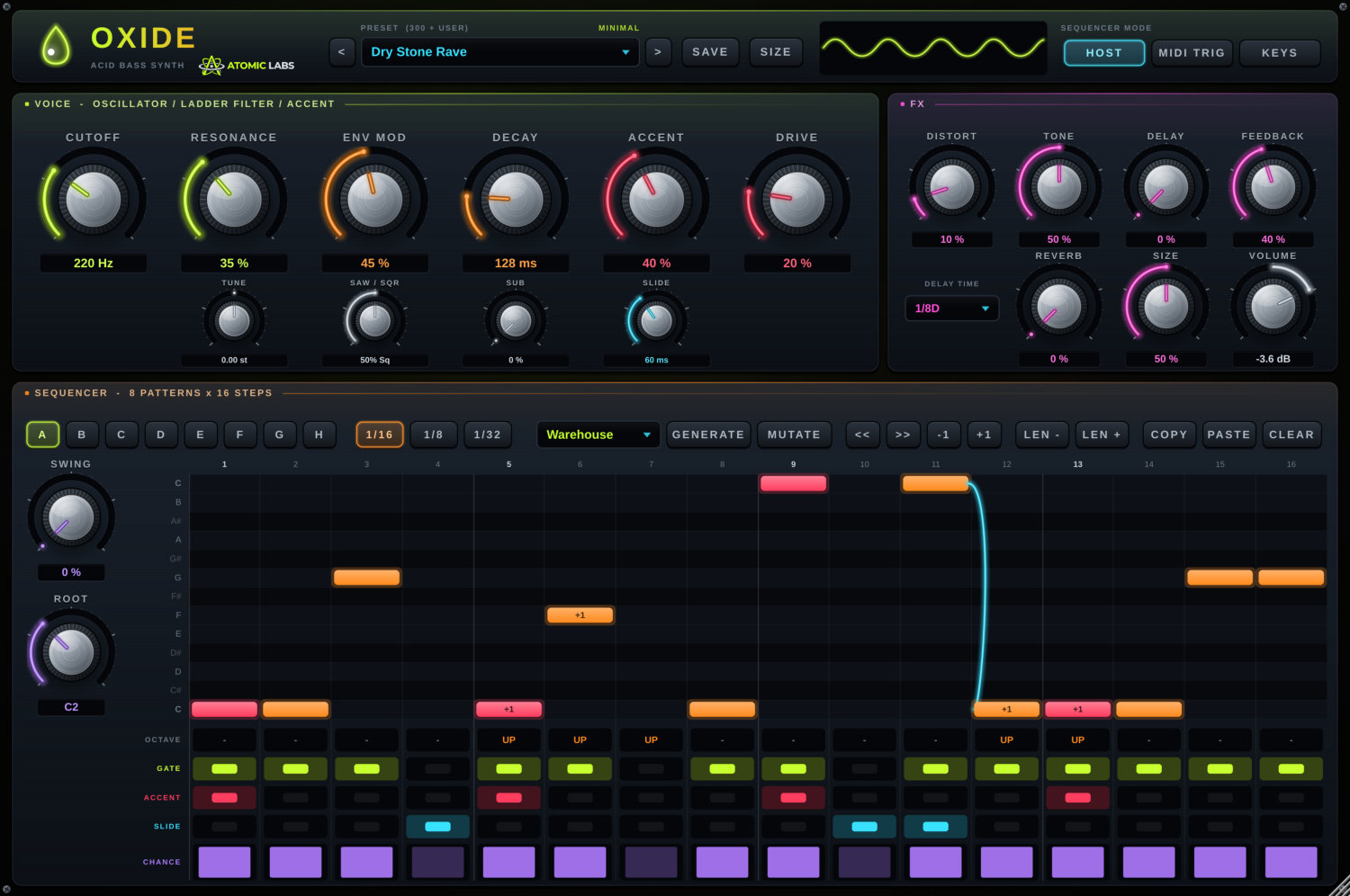
Acid bass-line synthesizer with sequencer
300 presets · 23 controls
Delay times for every note value, reverb pre-delay and decay, tap tempo, and a loop you can hear with straight, dotted and triplet echoes.
FreeDescribe a sound in plain words and get a synth patch you can play on your keyboard, tweak, and save as a patch file or WAV.
FreeBuild a wavetable from harmonics, a formula or your own drawing, watch it morph in 3D, hear it, and save a WAV for your wavetable synth.
FreeSplit a song into 6 stems (vocals, drums, bass, guitar, piano, other) on your own computer, mix them and save each one as WAV.
All toolsEverything we make for free, in one place, and what's coming next.
Shop151 instruments and effects for every Windows DAW.