
Effect
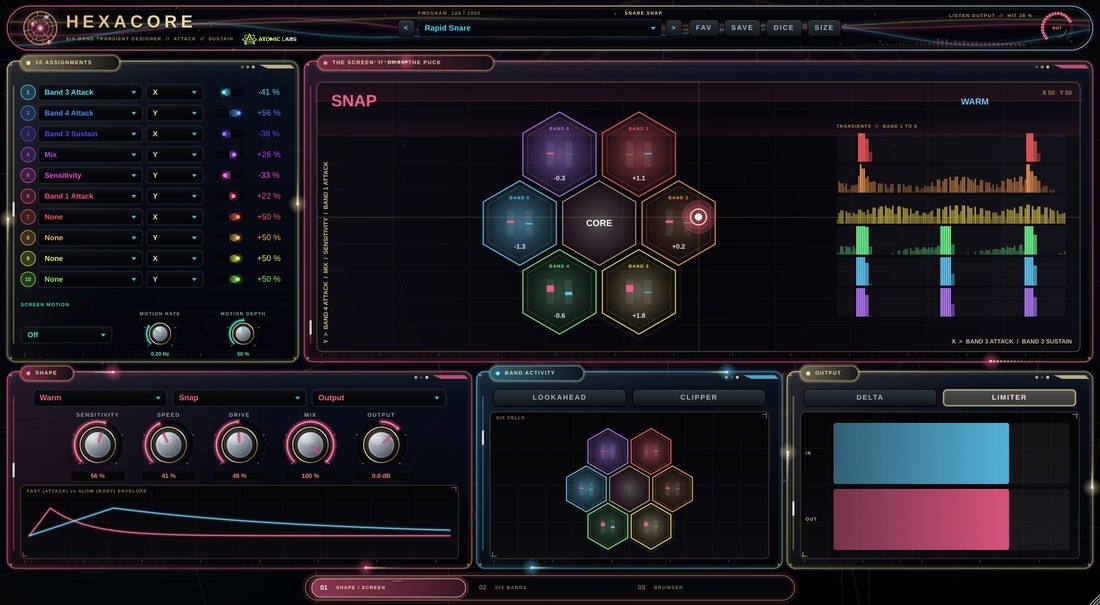
Hexacore
Six-band transient designer: shape the attack and the sustain of every frequency range
1,000 presets · 68 controls
Coming soonGet the pack
Drop in a song and an AI model splits it into vocals, drums, bass, guitar, piano and other, right on your computer. A recipe for your genre then makes 20 labelled layers. Mix them, hear them against the original and save WAV files. Nothing is uploaded.
WAV, MP3, FLAC, OGG or M4A, up to about 10 minutes
Choose a fileAuto picks a recipe after the AI split, from the stems' balance and the tempo. AI layers come from the model, DSP layers are splits of an AI stem.
The first split downloads the AI model once: about 75 MB, plus the engine (15 MB, or 29 MB for graphics cards). Your browser keeps them for next time.
Waiting for a song
Pick a song to start. It never leaves your computer.
The AI model always makes the same 6 stems. What the 14 detailed layers are depends on the genre: each recipe splits the stems where that kind of music has its parts. Auto-detect looks at the balance of the stems and the tempo and picks one; it is a guess, so change it if it's wrong. Every recipe also gives 6 group stems, such as the acapella and the instrumental.
| Genre | The detailed layers |
|---|---|
| Psytrance / goa | Kick, rolling sub and upper bass, hats, plucks and acid lines, pads |
| House / techno | Four-on-the-floor kick, clap, open and closed hats, bassline, stabs, pads |
| Drum & bass / dubstep | Breaks, sub, mid-bass growls, leads and atmos |
| Hip-hop / trap | Rap vocal and ad-libs, kick, clap, hat rolls, 808 sub and 808 tone, melody |
| Pop | Lead and backing vocals, drums in four layers, sub and upper bass, keys, synths |
| R&B / soul | Smooth lead and harmonies, groove drums, deep bass, keys and pads |
| Rock | Lead and backing vocals, kick, snare, toms, hats, crash and ride, centre and side guitars, bass |
| Metal | Vocals, double kick, snare, toms, cymbals, rhythm and lead guitars, bass |
| Acoustic / folk | Voice and harmonies, centre and side acoustic guitars, fiddle and strings, plucked strings, light percussion |
| Jazz | Voice, kick, snare and brushes, toms, hats and ride, upright bass, piano left and right hand, horns low and high |
| Latin | Vocals, kick, timbales and snare, congas and bongos, shakers, bass, montuno keys, horns |
| Reggae / dub | Vocals, one-drop drums, deep sub and bass tone, skank chops, organ bubble |
| Classical / orchestral | Soloist and choir, low and high percussion, basses, harp, keys, low strings and brass, mid and high sections |
| Ambient / cinematic | Voice and wide voices, impacts and ticks, sub and bass, textures, pads centre and wide, keys, guitar swells |
The AI part is htdemucs_6s, the six-source Hybrid Transformer Demucs model released by Meta under the MIT licence. We exported it ourselves to run in the browser with ONNX Runtime Web: on your graphics card through WebGPU where the browser has it, otherwise on your processor through WebAssembly. Your song is cut into 7.8-second pieces that overlap, each piece is split, and the pieces are blended back together, so long songs fit in memory.
The detailed layers come from classic sound processing on the AI stems: a Linkwitz-Riley crossover for sub and upper bass, a stereo-coherence split for lead and backing vocals or centre and side guitars, a median-filter split into short attacks and sustained sound, and a template-guided split of the drum stem into kick, snare, toms and cymbals. Each split takes one part out and keeps the rest as the other part, so nothing is lost: the 14 layers always add back to the original.
Need the delay time for a stem at your track's tempo? Use the delay calculator. Want a new sound to replace a part? Try Words-to-Synth.
Yes. No account, no limit on songs, no watermark and no queue. WAV export is free too.
No. The AI model is downloaded to your browser once, and the split runs on your own computer. Your audio never leaves it; you can even go offline after the model has loaded.
First the AI model makes 6 stems: vocals, drums, bass, guitar, piano and other. Then sound-processing (DSP) splits break them into 14 detailed layers, such as lead and backing vocals, kick, snare, hats, sub and upper bass, plus 6 group stems such as the acapella and the instrumental. Every file says AI or DSP, so you know which is which.
Each genre gets its own recipe for the 14 detailed layers. Rock splits the guitars into centre and side guitars, jazz splits the piano into left and right hand, orchestral music is split into low, mid and high sections, and electronic music gets kick, clap, hats, sub and upper bass. Auto picks one for you after the AI split; you can change it and remake the layers in seconds.
Vocals, drums and bass come out well on most music. Guitar and especially piano are weaker in this model, and the DSP layers are frequency, stereo and attack splits, not separate AI models, so a kick layer can hold some bass, for example. Big paid services use larger server models; our point is that this is free, private and has no queue.
Yes. The 14 detailed layers added together give back the original exactly (the last layer holds whatever the AI model left out). The 6 AI stems plus the Leftovers row do the same.
It depends on your computer. With a graphics card (WebGPU in Chrome or Edge) a song takes about as long as it plays, or less. On the processor alone it is slower: several minutes for a song. The page shows a live time estimate.
WAV, MP3, FLAC, OGG and M4A, whatever your browser can play. The stems are saved as 44.1 kHz stereo WAV, 24-bit or 32-bit float. Only split music you have the rights to use.
Atomic Labs effects for drums, bus glue, low end and the final mix.
Six-band transient designer: shape the attack and the sustain of every frequency range
1,000 presets · 68 controls
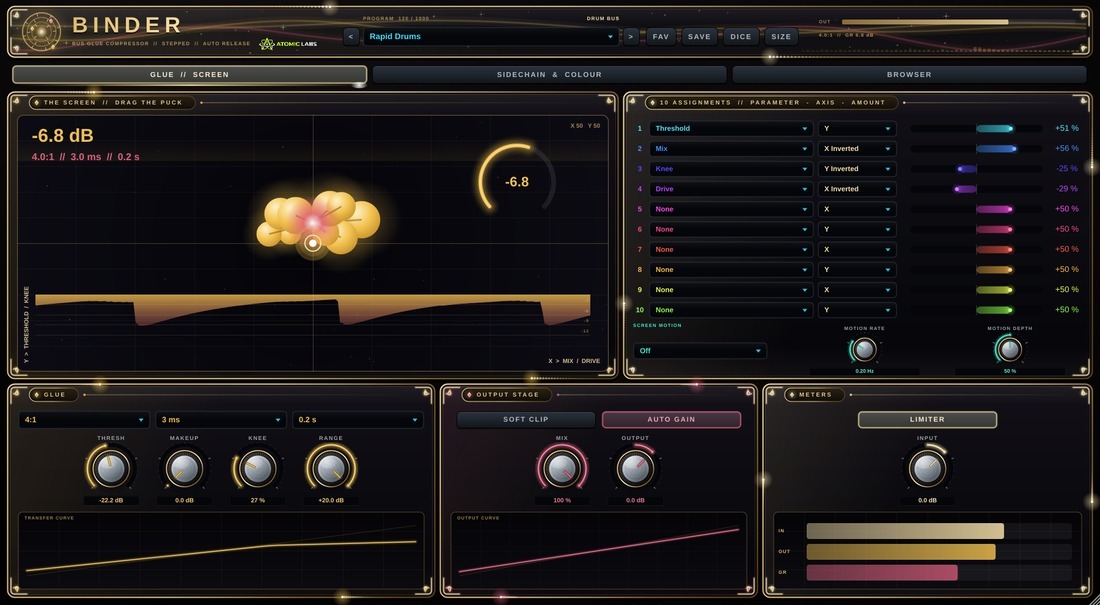
Bus glue compressor with stepped ratio, attack and release, auto release, sidechain filter and soft clip
1,000 presets · 55 controls
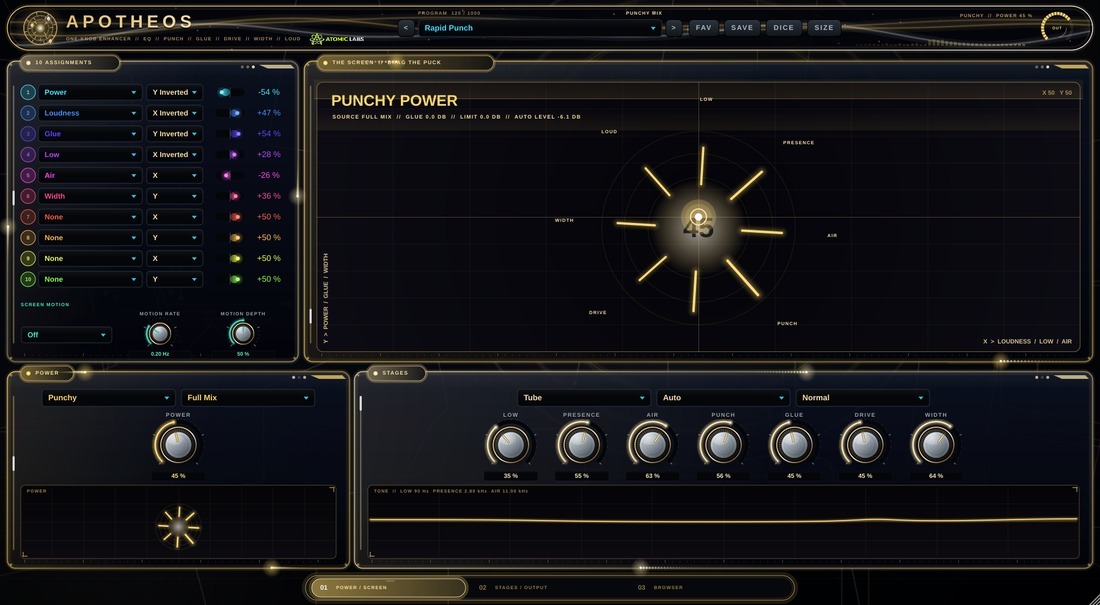
One-knob mix enhancer: power drives eq, punch, glue, drive, width and loudness at once
1,000 presets · 57 controls
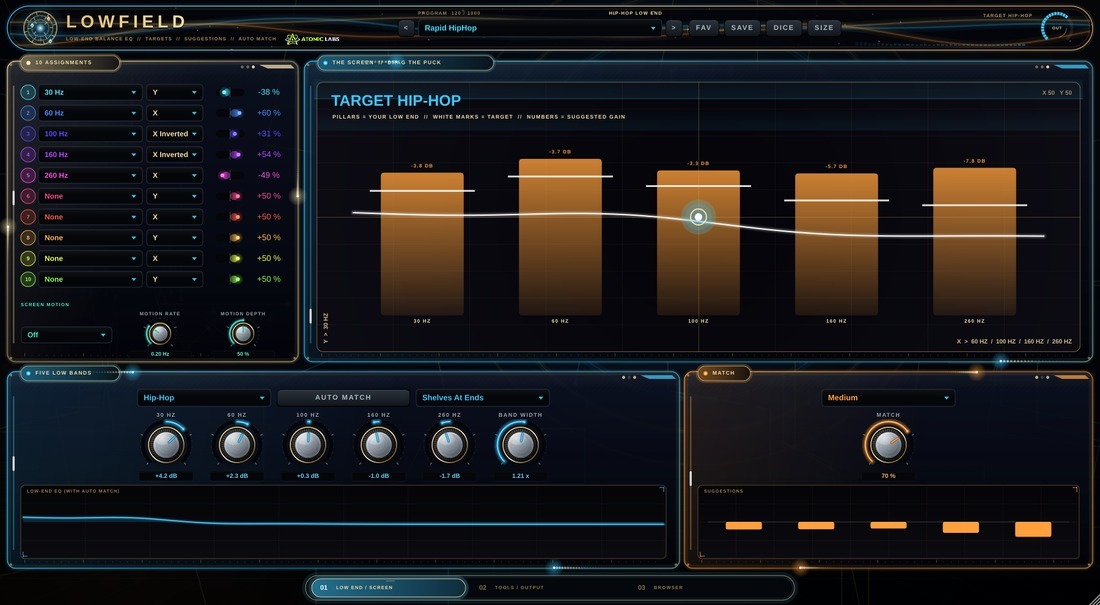
Low-end balance eq: measures your lows against a style target and suggests the fix
1,000 presets · 56 controls
Delay times for every note value, reverb pre-delay and decay, tap tempo, and a loop you can hear with straight, dotted and triplet echoes.
FreeTurn any frequency into its note, cents and MIDI number, or a note into Hz, at 432, 440, 442 or your own A4. With a full note table and tones to compare.
FreeDescribe a sound in plain words and get a synth patch you can play on your keyboard, tweak, and save as a patch file or WAV.
FreeBuild a wavetable from harmonics, a formula or your own drawing, watch it morph in 3D, hear it, and save a WAV for your wavetable synth.
All toolsEverything we make for free, in one place, and what's coming next.
Shop151 instruments and effects for every Windows DAW.